Monday, December 26, 2022

Digital Personal Data Protection Bill 2022 – History & Impact in Healthcare Industry


On November 18, 2022, the Ministry of Electronics and Information Technology (MeitY) released the draft of the Digital Personal Data Protection Bill, 2022 (DPDP Bill 2022), inviting suggestions and comments from relevant stakeholders. In its fourth iteration since 2017, the DPDP Bill 2022 attempts a better ‘comprehensive legal framework’. Previous versions of the proposed general data protection legislation drew heavily upon European Union’s General Data Protection Regulation (GDPR) and were dense, voluminous documents, etc. The Bill draws inspiration from Singapore’s Personal Data Protection Act, 2012, and is a condensed and concise document. The new bill is a lot simpler than the previous one as it is having only 24 pages as compared to 70 pages as well as 30 guidelines as compared to 90 in the previous draft bill.


Let’s first understand the status of privacy in the Indian context. As per Part III of the Indian Constitution, we have many fundamental rights like Right to Life & Personal Liberty, Right to Equality, Freedom of Speech & Expression, etc. Fundamental rights provide a high degree of protection from encroachment but the fundamental right to privacy was not guaranteed under the Constitution of India till 2017. Before 2017 in many cases e.g. M. P. Sharma vs. Satish Chandra and Kharak Singh v. State of Uttar Pradesh, the status of Privacy was not recognized as a Fundamental right. In Justice K. S. Puttaswamy v Union of India, the nine Judge Bench unanimously reaffirmed the right to privacy as a fundamental right under the Constitution of India. As per instruction of the Supreme Court of India an expert committee headed by Justice B. N. Srikrishna was created to examine various issues related to data protection in India. The Committee submitted its report and a draft Personal Data Protection Bill, 2018 to the Ministry of Electronics and Information Technology.

Provisions related to Protected Health Information (PHI) are governed by the Information Technology Act, 2000, together with the Information Technology (Reasonable Security Practices and Procedures and Sensitive Personal Data or Information) Rules, 2011. Patient data, including health information, is treated as sensitive personal data or information and under the IT Act offers some degree of protection to the collection, disclosure, and transfer of sensitive personal data. Also long before DPDP Bill 2022, the Government introduced the Digital Information Security in Healthcare Act (DISHA), India’s counterpart of the Health Insurance Portability and Accountability Act (HIPAA), aimed at providing healthcare data privacy, security, confidentiality, and standardization and establishment of the National Electronic Health Authority (NeHA) and Health Information Exchanges. While the purpose of this act is to encourage the pan-India adoption of e-health standards, DISHA has not yet come into force.


Digital Personal Data Protection 2022 Bill operates on a triad - Data Principal, Data Fiduciary, and Grievance Resolver. Unlike the GDPR, the bill boldly defines “harm”, “loss”, and “public interest” in small lists. A first in India’s legislative history, the bill uses “her” and “she” for an individual, irrespective of gender—a welcome populist and inclusive move. The Bill mandates obtaining consent for processing after providing notice in clear and plain language, “describing” the type of personal data sought to be collected and an ‘itemized’ list of the purposes of the processing. PDDP Bill 2022 allows the transfer of personal data outside India to countries notified by the Indian government.


The provisions for penalties in DPDP Bill 2022 Bill fall far short of other data protection legislation around the world, such as GDPR or similar laws in China. In the proposed bill, Healthcare Organizations are subject to penalties of up to 500 crores for non-compliance. Other than that, the bill includes a laundry list of penalties: up to 250 crores for failing to take adequate precautions against data breaches; 200 crores for failing to notify of a breach or complying with provisions related to children; 10 crores for violating data localization norms; 150 crores when a significant Healthcare Organization fails to carry out their additional obligations under the proposed law. A key ingredient in laws in other countries is the power to impose penalties up to a particular amount as prescribed for offenses or as a percentage of total worldwide turnover, whichever is higher.

A data principal is under an obligation to not register a false or frivolous complaint with a data fiduciary or the Board, not to furnish any false particulars or suppress any material information. DPDP Bill 2022 has introduced a penalty of up to 10,000/- (Rupees Ten Thousand) on the data principal for failure to comply with its proposed obligations.


The proposed DPDP Bill 2022 introduces the concept of ‘Deemed Consent’ where the data principal is deemed to have given consent for processing their personal data. Consensual processing of Personal Data may be done in case of medical emergencies involving a threat to life or an immediate threat to the health of the Data Principal. In the context of such processing, a parallel may be drawn with India’s draft Health Data Management Policy by NDHM released in April 2022 which also envisages provisions relating to the processing of Personal Data in case of medical emergencies. Notably, the NDHM contemplates the appointment of a nominee to provide valid consent on behalf of the Data Principal in case such Data Principal becomes seriously ill, or mentally incapacitated, or where the data principal is facing a threat to life or a severe threat to health and is unable to give valid consent. Unlike the DPDP Bill 2022, the NDHM does not propose Deemed Consent in absence of a nominee but rather shifts the right to give valid consent on behalf of the Data Principal to an adult member of the family of the Data Principal.

Despite the recommendation under the JPC Report, the DPDP Bill 2022 has kept the 'Non-Personal Data' of the individuals such as information collected by the Government, NGOs, and other private sector entities, outside its ambit. The usage of phrases 'as it may consider necessary' and 'as may be prescribed' can lead to administrative ambiguities. The autonomy of the Data Protection Board which is entrusted with overseeing the protection of individual's personal data and ensuring compliance with the provisions of the law is not reassuring. Further, the Government and its instrumentalities can retain personal data for an indefinite period irrespective of whether the purpose for which data was processed has been fulfilled.

By 2030 India is projected to be the world’s third-largest economy and will have one of the world’s largest digital personal data footprints in motion and at rest. The DPDP 2022 Bill’s essentiality shines in our strengthening role in the global order. With the G20 Presidency and multiple Free Trade and Regional Trade Agreements in place, we will have to find solutions for Data Free Flow with Trust and cross-border data flows.

Thursday, February 10, 2022

Security & Privacy by Design - 'The Guiding Principle' of Health Data Management Policy by ABDM

Every byte of data has a story to tell. The question is whether the story is being narrated accurately and securely. Usually, we focus sharply on the trends around data with a goal of revenue acceleration but commonly forget about the vulnerabilities caused due to bad data management. Data possesses immense power, but immense power comes with increased responsibility. In today’s world collecting, analyzing and build prediction models is simply not enough. Keep in mind that we are in a generation where the requirements for data security have perhaps surpassed the need for data correctness. Hence the need for Privacy By Design is greater than ever.

“Privacy by Design” and “Privacy by Default” have been frequently-discussed topics related to data protection. The first thoughts of “Privacy by Design” were expressed in the 1970s and were incorporated in the 1990s into the RL 95/46/EC data protection directive. Privacy by design is an approach to systems engineering that seeks to ensure protection for the privacy of individuals by integrating considerations of privacy issues from the very beginning of the development of products, services, business practices, and physical infrastructures. The adoption of security and privacy principles is a crucial step in building a secure, audit-ready program.

Privacy by Design is based on following 7 principles:

  1. Proactive not Reactive; Preventative not Remedial - Privacy by Design comes before-the-fact, not after.
  2. Privacy as the Default Setting - it is built into the system, by default.
  3. Privacy by Design is embedded into the design and architecture of IT systems and business practices
  4. Privacy by Design seeks to accommodate all legitimate interests and objectives in a positive-sum “win-win” manner not Zero-Sum
  5. End-to-End Security — Full Life-cycle Protection
  6. Visibility and Transparency — Privacy by Design seeks to assure all stakeholders that whatever the business practice or technology involved, it is in fact, operating according to the stated promises and objectives,
  7. Respect for User Privacy — Keep it User-Centric

Privacy by Design in Health Data Management Policy by ABDM

Consider  data  protection  requirements  as  part  of  the  design  and  implementation  of  systems, services,  products  and  business  practices.  The  federated  design  of  the  National  Digital  Health  Ecosystem ensures  that  no  personal data other than  what  is  required  at  a  minimum  to  create  and  maintain  Health  IDs,  Facility  IDs  or  Health  Professional  IDs shall  be  stored  centrally.  Electronic  medical  records  shall  be  stored  at  the  health  facility  where  such  records  are created,  or  at  such  other  entities  as  may  be  specified  by  Policy.  Electronic  health  records  shall be  maintained  by  entities  specified  by  Policy,  as  a  collection  of  links  to  the  related  medical records.  ABDM  shall  issue  appropriate  technological  and  operational  guidelines  providing  for  the establishment  and  maintenance  of  the  federated  architecture,  for  ensuring  the  security  and  privacy  of  the personal  data  of  data  principals,  and  for  maintenance  of  electronic  medical  records  and  electronic  health records.
Prepare  a  privacy  policy  containing  the  following  information:
(a)  clear  and  easily  accessible  statements  of  its  practices  and  policies;  
(b)  type of personal  or  sensitive  personal  data  collected; 
(c) the  purpose  of  collection  and  usage  of  such  personal  or  sensitive  personal  data;   
(d)  whether  personal  or  sensitive  personal  data  is  being  shared  with  other  data  fiduciaries  or  data processors;   
(e)  reasonable  security  practices  and  procedures  used  by  the  data  fiduciary  to  safeguard  the personal or  sensitive  personal  data  that  is  being  processed. 

The  privacy  policy  referred  shall  be  published  on  the  website  of  the  data  fiduciary.  In  addition, the  data  fiduciary  shall  also  make  available  a  privacy  by  design  policy  on  its  website  containing  the following  information:
(a)  the  managerial,  organisational,  business  practices  and  technical  systems  designed  to  anticipate, identify  and  avoid  harm  to  the  data  principal; 
(b)  the  obligations  of  data  fiduciaries; 
(c)  the technology  used in  the  processing  of  personal data,  in  accordance  with  commercially  accepted or  certified  standards; 
(d)  the protection of privacy throughout processing from the point of collection to deletion of personal data; 
(e)  the  processing  of  personal  data  in  a  transparent  manner;  and 
(f)  the  fact  that  the  interest  of  the  data  principal  is  accounted  for  at  every  stage  of  processing  of personal  data. 

The  privacy  policy  issued  and  the  principles  of  privacy  by  design  followed  by  the  data  fiduciaries  should be  in  consonance  with  this  Policy  and  applicable  law.


Saturday, July 18, 2020

Digital Healthcare – Laws & Regulations in India


Digital health is using technologies to help improve individuals' health and wellness. These technologies include both hardware and software solutions and services, including telemedicine, web-based analysis, email, mobile phones and applications, text messages, wearable devices and clinic or remote monitoring sensors. Really it's about applying digital transformation, through disruptive technologies and cultural change, to the healthcare sector. Digital health is a multi-disciplinary domain involving many stakeholders, including clinicians, researchers and scientists with a wide range of expertise in healthcare, engineering, social sciences, public health, health economics and data management.

Digital Healthcare has been around in India since long but COVID-19 pandemic has put it in the spotlight and we are noticing mass adoption as 5 crore Indians accessed healthcare online in the last three months (Practo’s Insights Report, 18 Jun3 2020). In a significant move, the Ministry of Health and Family Welfare (“MoHFW”) on March 25, 2020, has issued the Telemedicine Practice Guidelines to provide healthcare using telemedicine and that is another major reason behind surge in online consultations. Also these Guidelines are one of the best guidelines ever published and the reason that telemedicine practice will stay in India. The Guidelines have made the practice of text/audio/video based medical care legal and regulated and thus have given platforms (mobile apps, web portals & social media) as well as doctors the standards to follow.

The legal and regulatory framework in India is/will be govern by following relevant acts / bills –
  • Telemedicine Practice Guidelines by MCI & NITI Aayog, 2020
  • Personal Data Protection Bill, 2019
  • Information Technology Act, 2000 & Information Technology Rules 2011
  • Clinical Establishment Act, 2010
  • MCI Act, 1956 & MCI Regulations 2002
  • Indian Medical Council Act, 1956 and Indian Medical Council Regulations 2002
  • Drugs & Cosmetics Act, 1940 and Rules 1945
  • Other Service Providers Regulations under the New Telecom Policy 1999

In September 2013, MoHFW notified the EHR Standards (Electronic Health Record Standards) for India.  Those standards were chosen from the best available & previously used standards applicable to International EHRs, keeping in view their suitability to and applicability in India.  Accordingly the EHR Standards 2016 document is notified and is placed herewith for adoption in IT systems by healthcare institutions and providers across the country.  The MoHFW facilitated its adoption by making available standards such as the Systematized Nomenclature of Medicine Clinical Terminology (SNOMED CT) free-for-use in India, as well as appointing the interim National Release Centre to handle the clinical terminology standard that is gaining widespread acceptance among healthcare IT stakeholder communities worldwide.

In addition, the MoHFW has proposed a new bill named DISHA (Digital Information Security in Healthcare Act) to govern data security in the healthcare sector.  The purpose of this Act will be to provide for electronic health data privacy, confidentiality, security and standardization.  The MoHFW, through the proposed DISHA, plans to set up a statutory body in the form of a national digital health authority for promoting and adopting: e-health standards; enforcing privacy and security measures for electronic health data; and regulating the storage and exchange of electronic health records.

One of the most immediate changes that health tech companies may need to be prepared for is the cost of compliance – with the Personal Data Protection (PDP) Bill 2019. As of the current interpretation of the text of the PDP Bill, 2019 (which effectively can get signed into law at any time) there is no period provided to affected companies to comply with the data protection measures in the Bill. The requirement of having a privacy-by-design system in place means that for a lot of companies the cost of compliance will go up as they would have to upgrade/overhaul their data protection systems and software. This change would be akin to the one experienced by European companies when they needed to comply with the General Data Protection Regulation (GDPR), but at least, in that case, there was a period prescribed within which companies were permitted to overhaul their security systems.


If any IT company or startup into Digital Healthcare plans to offer and add telemedicine/telehealth software to already existing software like healthcare CRMs, clinical software and patient management systems, have to incorporate all the relevant Acts & guidelines. It will not only help their clients but also will help companies because as per Telemedicine Practice Guidelines, technology platforms are obligated to ensure many instructions otherwise can be blacklisted.

Monday, May 11, 2020

Digital Health: Why Digital Health will become the new normal


During COVID-19 pandemic, terms like telehealth, telemedicine, remote-patient monitoring, virtual care and digital health are thrown around very commonly, though these terms have been around for years, but the recent situation is accelerating patient awareness and physician adoption of these technologies.

With a growing need for social isolation, healthcare organizations are actively seeking ways to provide health services to patients with both COVID-19 and other conditions remotely.
Start-up investing is not a new phenomenon in the financial world, but one sector, in particular, has seen a veritable boom in investors since the beginning of the COVID-19 pandemic. While many industries plummeted in the first quarter of the year, digital health companies closed the first quarter of 2020 with unprecedented levels of funding. Private equity and venture capital financing of digital health start-ups reached an all-time high of just over $3 billion in Q1 2020

Digital health seeks to enhance administrative tools, clinical tools and patient interaction to make the healthcare experience more effective, efficient, and positive for patients. Healthcare is far behind in technology, and this industry is looking to fill that gap. Those of us who work in the digital health space want to take current healthcare experience, which is something like Blockbuster Video in the early 2000s and turn it into Netflix.

The Board of Governors in supersession of the Medical Council of India (MCI) issued Telemedicine Practice Guidelines on March 25 to strengthen delivery in a post-Covid-19 world, with a focus on Health and Wellness Centres (HWCs) that provide preventive and primary healthcare within a 5 km radius at the grassroots level.

Telemedicine is being used by doctors to connect with patients, and by mid-level provider/health workers to connect patients with doctors without patients having to physically visit a hospital or clinic. Even post lockdown, it will help reduce the burden on the secondary hospitals and improve documentation, data-collection, diagnosis and care without risking the safety of the patients or the health workers. It is already being used with success in some states for reproductive and child health and tuberculosis notification and outreach.

There is a persistent shortage of doctors, health workers and hospital beds in the country, especially in rural areas and densely populated underserved states. India has 1.1 million allopathic doctors registered with the Board of Governors/State Medical Councils in December 2019, according to the National Health Profile 2019.

India’s public health expenditure is just 1.28% of its GDP, with the per capita public health expenditure being Rs 1,657 in 2017-18. The rising cost of treatment has led to inequities in access, with people in under-served rural areas and urban slums among the worst hit. For people living in rural areas completely dependent on government hospitals and clinics, the government allopathic doctor-patient ratio is 1:10,926, shows NHP 2019 data.

For a population of 1.36 billion, this makes the doctor-population ratio 1:1,457, which is lower than the WHO recommended norm of 1:1,000. In addition to doctors, India has a little more than two million registered nurses and midwives, many of whom need infection control training to care for patients with communicable diseases, such as Covid-19 and tuberculosis. The WHO estimates there is a deficit of 6 lakh doctors and 20 lakh nurses in India. Further, doctors often have to perform many routine tasks like data entry, patient management; pharmacy interfacing, ensuring the right gear and equipment are present in the required quantities at the point-of-need, and so on—over and above their medical and caregiving duties.

Before Telemedicine Practice Guidelines, there was no legislation or guidelines on the practice of telemedicine through video, phone, and online platforms, which include the web, apps, chats, etc. The existing provisions under the MCI Act, 1956, MCI Regulations 2002, Drugs & Cosmetics Act, 1940 and Rules 1945, Clinical Establishment Act, 2010, Information Technology Act, 2000 and the Information Technology Rules 2011 primarily governed only the practice of medicine and information technology.

With such a large rural population and insufficient trained medical staff and rural healthcare facilities, India can rapidly adopt telemedicine capabilities to make up for the gap. E-consultations, which took off during the lockdown, can vastly improve access to healthcare in rural areas. Mobile and internet penetration in rural areas is accelerating, and telehealth can piggyback on this trend. A quick e-consultation can determine whether the person has a simple problem or needs to access a facility for a physical check-up. We may find that 50-60% of cases could be diagnosed in this manner, and the remaining might have to travel for a consultation—largely reducing the healthcare burden in the country.

Wednesday, June 19, 2019

Blockchain in healthcare: The Ultimate use case?

Many people have heard a lot about the blockchain in frames of a cryptocurrency called Bitcoin; however, it can have a much wider use than a simple payment method, including various industries. So, how does blockchain actually work in the healthcare industry? 

Health Care and Interoperability


Interoperability is a huge problem in the healthcare industry. In fact, improved healthcare interoperability is been a top priority for providers, policymakers, and patients for quite some time now.
So what are the two major areas when it comes to ineffective interoperability?
  • The trouble of identifying patients
  • Information blocking

The trouble of Identifying Patients

One of the most surprising things that we learned while researching for this guide. Apparently, there is still no universally recognized patient identifier. This despite the fact that organizations like CHIME and HIMSS have been pushing for its development for almost two decades.
  • This is truly shocking when you consider the fact that a unique patient identifier will be able to easily solve the problem of mismatched patient EHRs (Electronic health record) which has in the past led to several errors in patient care and increased the likelihood of patient harm.
    This problem has been well expressed by the Director of Center for Biomedical Informatics (CBMI), Shaun Grannis.
    Matching the correct individual to his or her health data is critical to their medical care,” he says. “Statistics show that up to one in five patient records are not accurately matched even within the same health care system. As many as half of the patient records are mismatched when data is transferred between healthcare systems.”
    So, how can the blockchain potentially solve this problem? Well, let’s look into it in a bit. Before we do so let’s look at the second problem that we have here.

    Information Blocking

    Despite being deemed an illegal practice, information blocking has been a problem in the healthcare industry. What do we mean by information blocking?
    In the healthcare industry, information blocking is described as the result of “an unreasonable constraint imposed on the exchange of patient data or electronic health information.” According to the U.S. Office of the National Coordinator for Health Information Technology, there are three criteria for identifying information blocking:
    • There has been interference
    • There has been knowledge
    • There is no reason for the data to not be accessible.
    It goes without saying that information blocking practices that involve unreasonable interference and awareness are a huge detriment to an efficient healthcare practice. Blocking can take place because of policies that prevent the sharing of information as well as practices that makes sharing extremely impractical.
    The reason for this is pretty straightforward. Hospitals don’t want to lose out on patients and want to make it as difficult as possible for them to want to move on to another hospital.
    In this digital age, this should have been a draconian practice, but various surveys and studies say otherwise.
    • After surveying 60 HIE leaders, it was discovered that information blocking is extremely widespread and the various actions that have been taken to curb it are still extremely ineffective.
    • 50% of respondents that have been studied by Adler-Milstein reportedly engaged with health IT companies by participating in information blocking. A quarter of these respondents also said that hospitals and health systems are guilty of this practice.
    According to the researchers, information blocking can be curbed by one of the following methods:
    • By increasing transparency so that each and every action that has been taken by the participants can be accounted for.
    • There should be a strong financial incentive so that the participants will want to share information with each other.
    • A collaborative relationship between health IT companies, hospitals, and HIEs could further curb information blocking.
    Alright, so now we have acquainted ourselves with the interoperability issues that are eating up the healthcare industry from the inside. Now let’s see how the blockchain is going to help solve this issue.

    Public and Private Blockchains

    There are two specific kinds of blockchains out there:
    • Public Blockchains
    • Private Blockchains
    Since both are blockchains, they provide a peer-to-peer network which offers a decentralized and immutable ecosystem which are synchronized via consensus protocols.
    However, that’s where all the similarities end.

    Public Chains

    Public blockchains are the ones that we are most familiar with. Bitcoin, Ethereum etc. are all public blockchains and the reason why they are called so is pretty self-explanatory.
    They are completely open ecosystems where anyone can take part in the ecosystem. The network also has an in-built incentive mechanism which rewards participants for taking part more thoroughly in the system.
    So, that’s pretty awesome right, however, will the health care industry benefit from having a public blockchain? Well…not so much.
    Firstly, as has been extremely well documented, the blocks in bitcoin and ethereum have a storage issue. Bitcoin has a little over 1mb of space per block which is simply not enough to run the kind of transactions and store the kind of data that healthcare institutes require.
    Then we have the throughput problems which have also been pretty well-documented. Bitcoin can barely manage 7-8 transactions per second. The block confirmation time is 10 mins which just adds to the latency. Big healthcare institutes need to deal with huge blocks of transactions per day with near 0 latency. In fact, any sorts of latency can potentially be life-threatening
    Public blockchains, especially the ones that follow the proof-of-work protocol like Bitcoin require an immense amount of computational power to solve hard puzzles. As such, it is really impractical for these institutes to spend so much money on consensus mechanisms.
    Finally, public blockchains are open chains, which in itself is another detriment. Think about it, why should healthcare institutes try to interact with each other in a network where anyone can come in and become a part of it. Medical insitutes deal with highly-classified and sensitive data, why will they want anyone outside their circles to interact with it?
    So, public chains are impractical for these purposes. However, there is one more kind of blockchain that is practical for healthcare institutes, and they are called private blockchains.

    Private Chains

    Private chains are..well…private.
    Unlike public blockchains, these aren’t open to everyone. As a result, people who want to participate in the private chain must gain permission to be a part of this network. This is the reason why private chains are also called “permissioned blockchains.”
    Because of this, there are restrictions to the kind of people who can actually take part in the consensus. Access for new participants could be given by the following:
    • The existing participants who are taking part in the ecosystem.
    • A regulated authority.
    • A consortium.
    Once an entity has joined the ecosystem, they can play a role in network maintenance. The Linux Foundation’s Hyperledger Fabric is an example of a permissioned blockchain framework implementation and one of the Hyperledger projects hosted by The Linux Foundation. It has been designed ground up to cater to these enterprise requirements.
    These private chains have been specifically designed for enterprise needs and offer a lot of features like:
    • Fast transactions
    • Privacy
    • High security
    Ok, so we have one side of the equation, which is the private chain. However, there is one more piece of the puzzle that we must understand before we wrap our heads around how the medical industry will work on the blockchain.

    Cryptographic Hash Functions

    Hashing means taking an input string of any length and giving out an output of a fixed length. In the context of cryptocurrencies like Bitcoin, the transactions are taken as an input and run through a hashing algorithm (Bitcoin uses SHA-256) which gives an output of a fixed length.
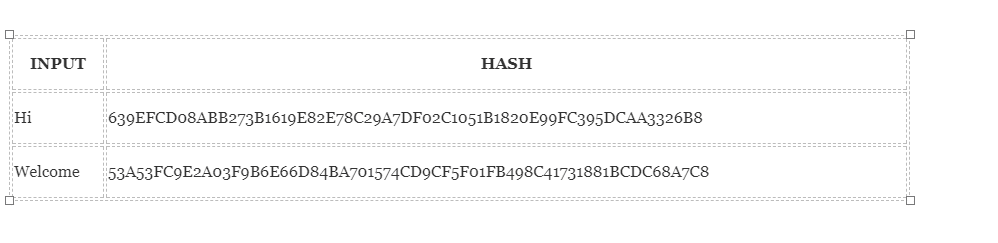
    Let’s see how the hashing process works. We are going put in certain inputs. For this exercise, we are going to use the SHA-256 (Secure Hashing Algorithm 256).
    Blockchain Usecases: Healthcare
    There are quite a lot of properties that makes hash functions pretty darn useful. We have covered these earlier, however, let’s focus on a few of them for now.

    Property 1: Deterministic

    This means that no matter how many times you parse through a particular input through a hash function you will always get the same result. This is critical because if you get different hashes every single time it will be impossible to keep track of the input.

    Property 2: Pre-Image Resistance

    What pre-image resistance states is that given H(A) it is infeasible to determine A, where A is the input and H(A) is the output hash. Let’s take an example.
    Here is a hash:
    559AEAD08264D5795D3909718CDD05ABD49572E84FE55590EEF31A88A08FDFFD
    Can you determine what was the input that generated this exact hash? You will have a hard time determining it. It won’t be impossible, it will just be extremely irritating and time-consuming.

    Property 3: Snowball Effect

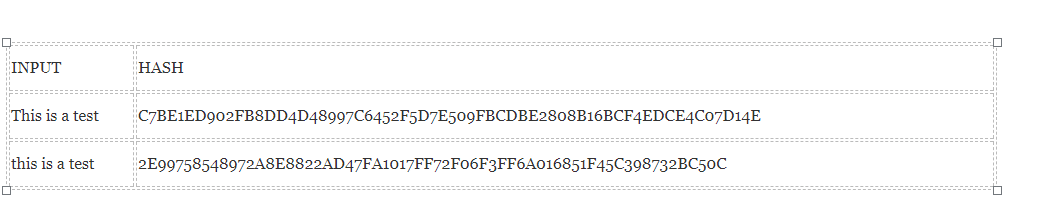
    This property states that even if you make a small change in your input, the changes that will be reflected in the hash will be huge. Let’s test it out using SHA-256:
    Blockchain Usecases: Healthcare
    You see that? Even though you just changed the case of the first alphabet of the input, look at how much that has affected the output hash.
    Now let’s bring it all together and see how a permissioned blockchain can help end the interoperability problem in the healthcare industry.

    Permissioned Healthcare Blockchain

    Imagine a network on healthcare institutes where they don’t own a patient’s personal data. The data all belong in the blockchain. The patients are identified via their hash ID which will be their unique identifier. The hashing allows the ID to be unique and secures the privacy of the user (see Property #2 above).
    The blockchain can also aid in the creation of a patient information sharing marketplace. This way, it will be possible to actually incentivize information sharing between the different institutes to prevent any kind of info blocking.
    However, what if we still have some malicious actors who attempt to do information blocking or tampering?
    In that case two of the blockchain’s most significant features will step up and handle this situation:
    Firstly, the blockchain is a transparent medium. Anyone, who is part of the network, can look into the blockchain and look at how each transaction takes place and whether all the relevant information is getting passed through or not.
    Secondly, we have anti-tampering.
    If anyone tries to block the data then via the snowball effect, it will change the hash drastically. Now, remember, that the blocks in the blockchain are linked to one another via a hash pointer. Each block in the blockchain stores the hash of the data that is stored in the previous block. If the data inside any one of the blocks change, it sets up a chain reaction which could freeze up the whole blockchain. Since this is a theoretical impossibility, it is impossible to tamper with any data that is inside the blockchain.

    Other Advantages of the Medical Healthcare Blockchain

    So, now that we know how interoperability can be solved, what other amazing advantages can the blockchain bring to the medical healthcare institute?
    • Since the blockchain is Immutable and traceable, patients can easily send records to anyone without the fear of data corruption or tampering.
    • Similarly, a medical record that has been generated and added to the blockchain will be completely secure.
    • The patient can have some control over how their medical data gets used and shared by the institutes. Any party which is looking to get the medical data about a patient could check with the blockchain to get the necessary permission.
    • The patient can also be incentivized to for good behavior via a reward mechanism. Eg. they can get tokens for following a care plan or for staying healthy. Also, they can be rewarded by tokens for giving their data for clinical trials and research
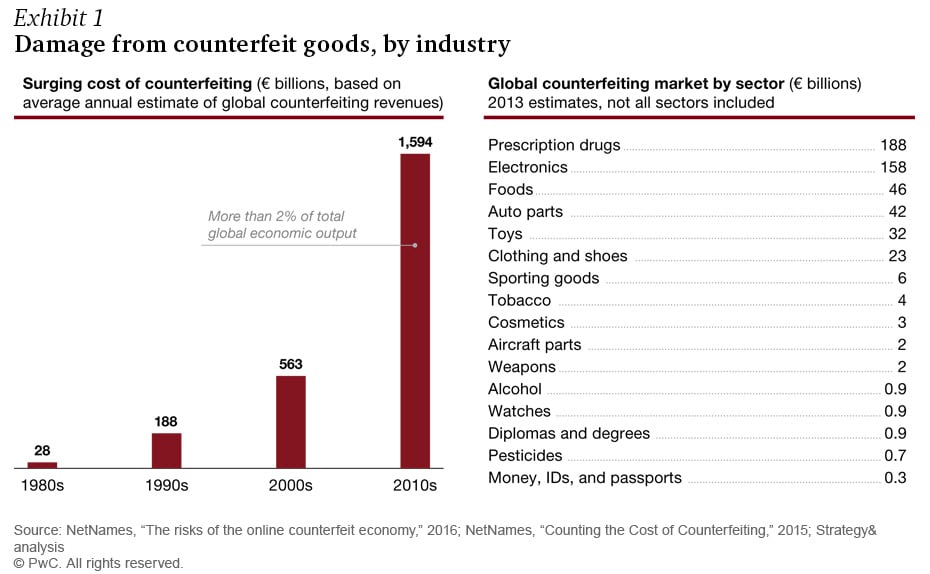
    • Pharma companies need to have an extremely secure supply chain because of the kind of product they carry. Pharma drugs are consistently stolen from the supply chain to be sold illegally to various consumers.  Also, counterfeit drugs alone cost these companies, nearly $200 billion annually. A transparent blockchain will help these companies to enable close tracking of drugs to their point of origin and thus help eliminate falsified medication.

    Blockchain in healthcare
    Image Credit: PwC 
    • Various medical institutes around the world conduct their own research and clinical trials on various new drugs and medications. A blockchain will help create a single global database to collect all this data and put them in one place.
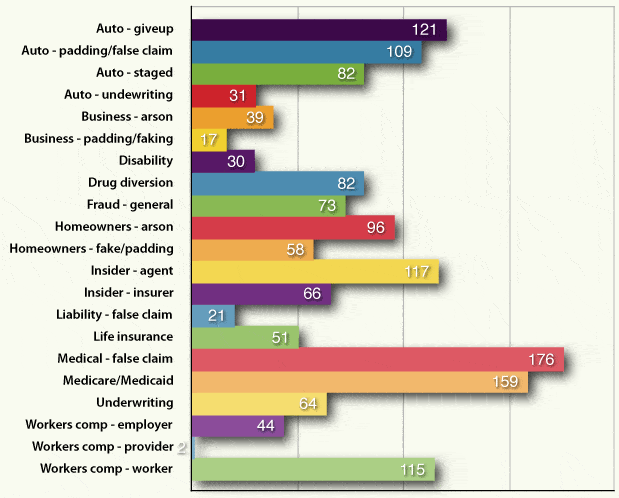
    • Insurance fraud is a major problem that is affecting the healthcare industry. This happens when dishonest providers and patients submit false claims/information to receive payable benefits. To get an understanding of how serious this problem is, try to wrap your head around this: According to Boyd Insurance, Medicare fraud in the U.S. alone costs about $68 billion a year.

    Blockchain in healthcare
    In fact, according to the charts, the top two kinds of healthcare frauds are healthcare related.

    Jack Liu, CEO of ALLIVE, an intelligent healthcare ecosystem based on blockchain technology, believes that the blockchain is going to help solve this problem. According to him,

    A blockchain environment can eliminate a large portion of this fraud when providers and patients must enter their information and data to be verified, recorded and stored and health insurance companies must have access to that data.”
    Since all the data will not be stored in a centralized infrastructure, it will be impossible to hack the system and get their hands on all of the data. This keeps the system leakage-free and it also helps secure the privacy of the patients.

    The Detractors

    Obviously, not everyone is on-board with the idea of basing the healthcare industry on the and around the blockchain technology. One of those detractors happens to be John Halamka, the Chief Information Officer of Beth Israel Deaconess Medical Center in Boston, a Harvard University teaching hospital. He has already worked on several production blockchain applications, so he is intimately familiar with how it works and its potential use-cases.
    According to him,
    Blockchain is not meant for storage of large data sets. Blockchain is not an analytics platform. Blockchain has very slow transactional performance. However, as a tamperproof public ledger, blockchain is ideal for proof of work. Blockchain is highly resilient”.

    Blockchain in HealthcareConclusion

    So, there you have it. We have listed down the various advantages that the blockchain can potentially impart to the healthcare industry. Obviously, until we see a proper implementation of this partnership, this is all hearsay. What we can state for a fact, is that various other institutes and spaces have already started experimenting and working with the blockchain technology.
    This space has no lack of money. In fact, consider the following statistics:
    • The funding of digital health startups reached an all-time high in the first quarter of 2018
    • Global annual health spending surpassed $7 trillion dollars in 2015
    • By 2020, the global annual health spending is expected to have ballooned to over $8.734 trillion.
    As such, they should be under no financial constraints to research new and exciting technologies. All signs are pointing towards a decentralized medical future. Let’s see why.
    According to a report by BIS research, by 2025, the healthcare industry can save upto $100 billion per year by 2025 in data breach-related costs, IT costs, operations costs, support function and personnel costs, counterfeit-related frauds and insurance frauds if they incorporate the blockchain technology.
    The report also states that the use of
    a global blockchain in the healthcare market is expected grow at a CAGR of 63.85% from 2018 to 2025, to reach a value of $5.61 billion by 2025. The use of blockchain for healthcare data exchange will contribute the largest market share throughout the forecast period, reaching a value of $1.89 billion by 2025, owing to the use of blockchain to solve the most widespread problem in healthcare information systems related to interoperability and non-standardization that has created data silos in the industry.
    According to the report and the way the blockchain is being adopted by various sectors, it definitely looks like the future of the healthcare industry is indeed decentralized. Let’s hope that the blockchain technology provides the horizontal innovation boost to this industry that it desperately needs.
    Major portion of this article taken from